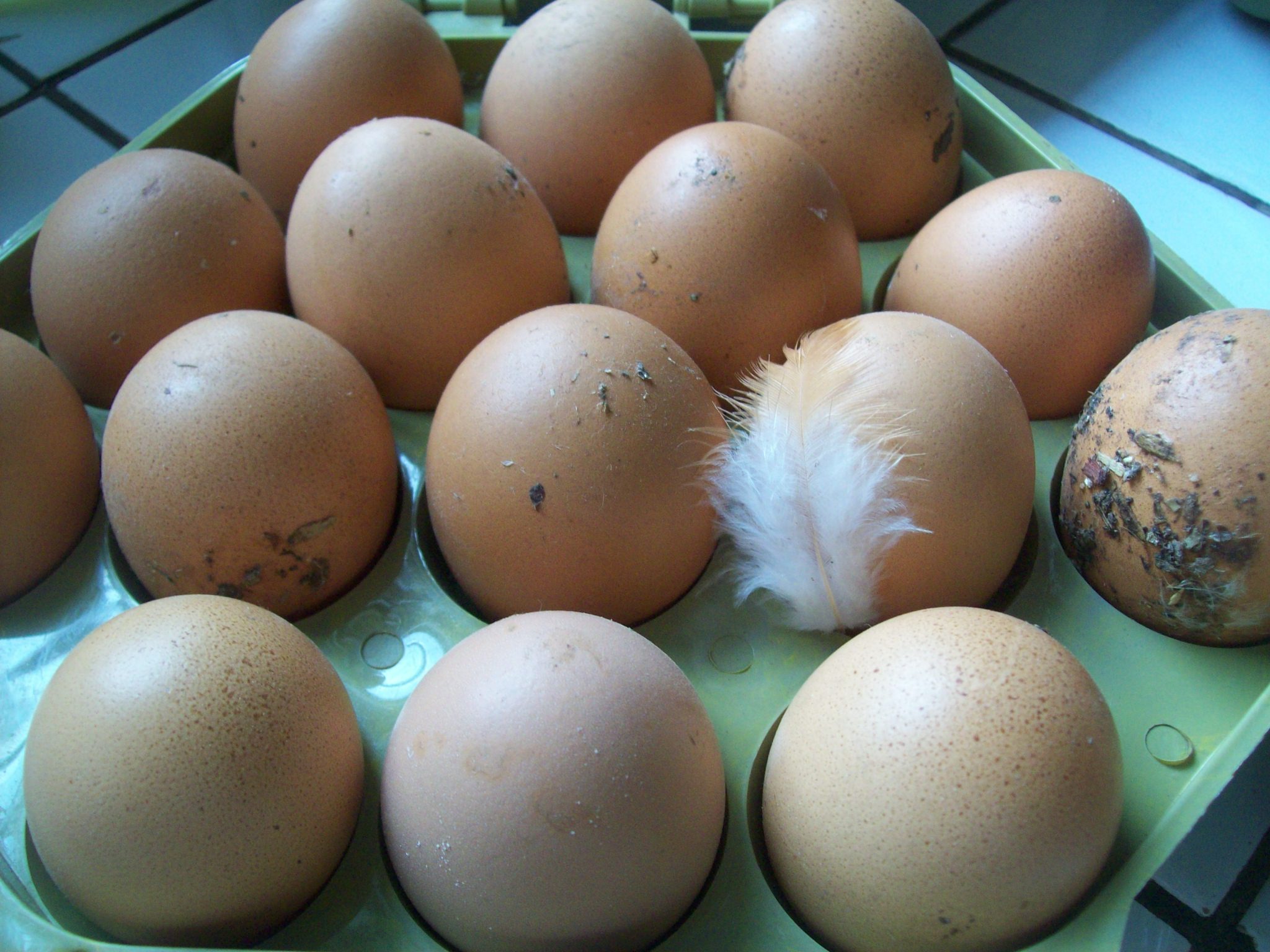
How fresh are your eggs? We know our eggs are fresh, however, there is an occasional rotten egg – pew wee. Today, as I was washing eggs, I thought one of my routine things might be of interest to you. We buy our eggs from a person on the road, who gets them from a person who pushes a large cart full of eggs straight from an egg farm (there are many homes with that indicate they have egg laying hens). This man collects the eggs from the egg farms to sell to the merchants on the road. We buy 30 eggs at a time (un plateau), but you can buy them individually too. They aren’t prepackaged, so you can either have your eggs placed lose in a sack or try to balance the flimsy cardboard with the eggs on top or buy a hard plastic egg holder, I was happy when I found the egg holder – we had many broken eggs before the holder. The eggs are not washed because they aren’t pasteurized. You can leave the eggs unrefrigerated for up to 2 or 3 weeks, once they are washed the natural protective layer has been removed and it’s necessary to refrigerate them. When the eggs are brought home, I wash 10 eggs to be refrigerated in soapy water and rinse them in filtered water. I dry them with a paper towel and place them in the refrigerator. As you can see they come home very dirty and they are brown. We haven’t seen a white egg since we left the States. That brings me to a question, why are the majority of eggs in the States white?
Water Filters
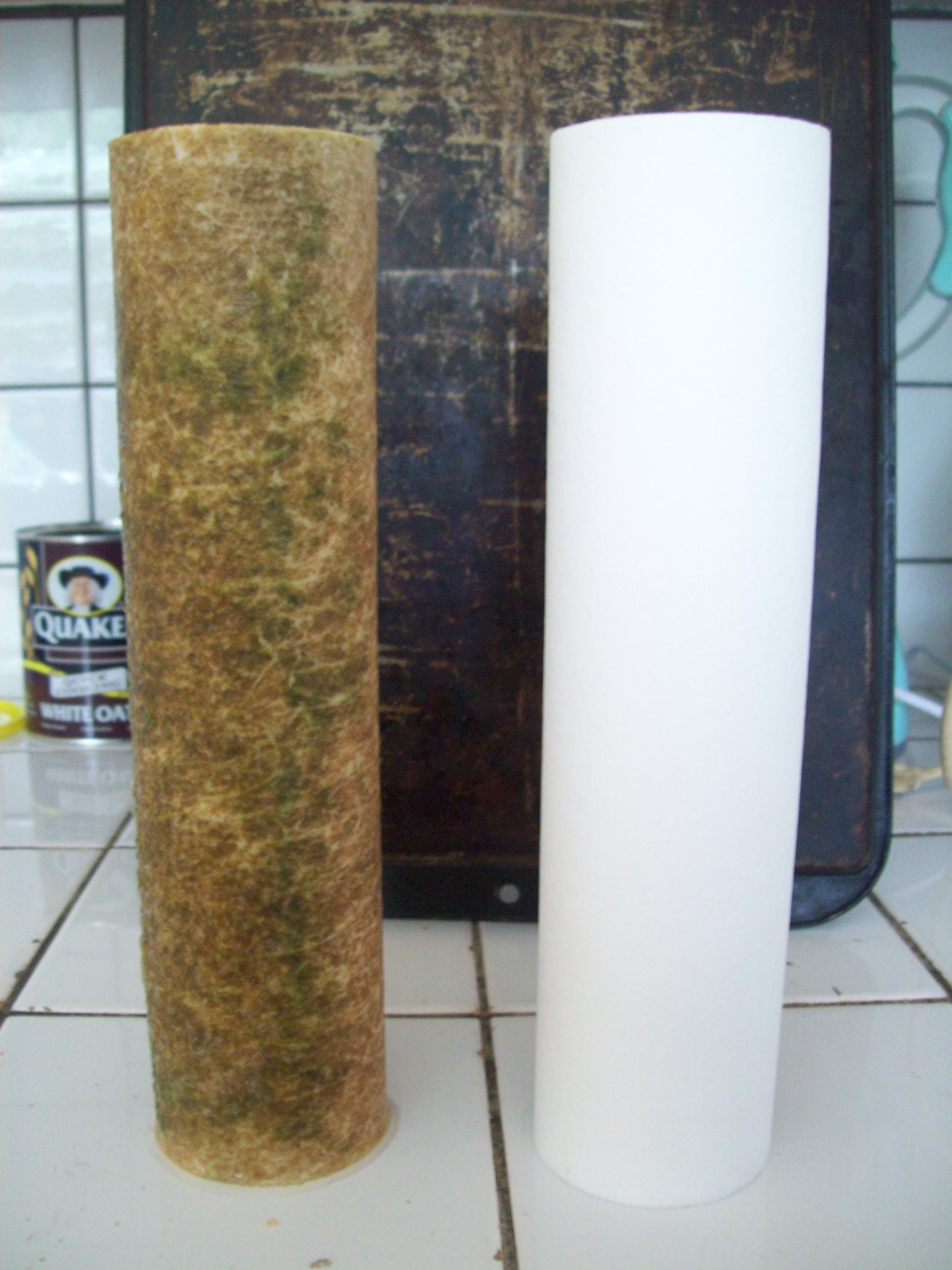
It’s necessary to use a water filter here because the water out of the tap is contaminated water, not only isn’t it treated, but it harbors bacteria and viruses that could make us very sick. We have been through many water filters trying to find the best system for our family. We have been using our current system for three months and were told we needed to change the sediment filter every three months. Today we changed it and took a comparison photo of the new cartridge and the dirty one needing to be replaced. If you ever wonder why our “white” socks are more of a reddish dirty color, you will know because our laundry water is tap water. We are very thankful for water filters so we can drink clean water!
Merry Christmas
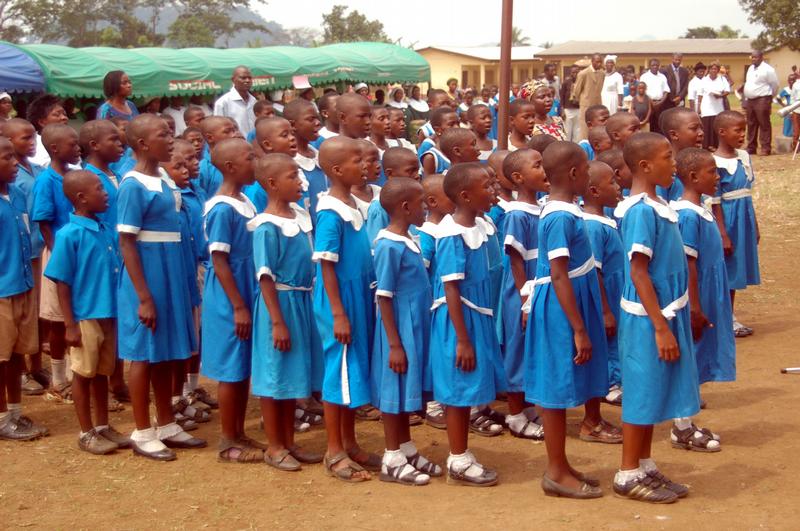
Joshua and his classmates recite the Christmas story from Luke 2 from memory before the Christmas play.
TCK (Third Culture Kid), MK (Missionary Kid)
Our children fall into the classification of the title of this blog. We were talking with a colleague who has served over 20 years in different roles and in many different countries in Africa. She is a lot of fun to talk to and has a good sense of humor. We got on the topic of educational differences due to environment where we live. Below are some highlights of our conversation.
Confusion using American curriculum for a child who lives in Cameroon:
What color is an orange? The child raised in the United States would answer – orange. The child raised in Cameroon would answer – green. (Yes, that’s right our oranges are green, when they turn orange they are rotten)
Where does peanut butter come from? The child raised in the United States would answer – store. The child raised in Cameroon would answer – the peanuts come from the lady on the street in an old liquor bottle, then you grind them into peanut butter.
What are the four seasons? The child raised in the United States would answer – winter, spring, summer and fall. The child raised in Cameroon would answer – there are only two seasons, wet and dry.
Where do you buy shoes? The child raised in the United States would answer – the store. The child raised in Cameroon would answer – from the man with the shoe on his head on the street or the man pushing the shoe cart on the street or the person with a pile of shoes on the side of the street.
The things parents forget:
When you live in a culture/society, you see and experience certain things without giving it a second thought. When you are trying to raise your children to understand your home culture, while living outside of your home culture, it’s hard to remember everything they would just pick-up if they were living in your home culture. Below are some stories we have heard and I’m sure we will get to add our own after we return on furlough.
A child that has been raised in Central African Republic returned to the United States and started public school. Everyone stood up, placed their hand over their hearts and recited proudly the Pledge of Allegiance. The child looked around and followed the standing up and placing his hand on his heart, but what were they reciting?
A mother so badly wanted her daughters to look like all the other kids when they arrived back on furlough. She had her sister send her popular patterns and material so she could make clothes so the girls would fit in. She proudly disembarked the plane with her husband and two daughters following them. She wondered why the passerby’s kept looking behind her puzzled. She turned around and saw that her daughters were carrying their suitcases on their heads.
No Shoes
When we first arrived in Cameroon, we noticed how the majority of missionary’s kids didn’t wear shoes outside. Usually the shoes would all be together in one spot while the kids ran to play. Tonight while eating dinner, Jonah told us that he learned about a place where people can’t wear shoes because shoes don’t exist there. He said he would like to live there and be free from shoes. It cracked us up that he spoke of shoes like they are feet prison and how he would like to be free from them.
At school you will find all the shoes in piles or objects in Capture the Flag, but rarely find them on the students’ feet.
No jack, no spare, no problem
The drive back from Tombel started off bright and early. We had made it past the several checkpoints without being stopped; the large checkpoint checking for fire extinguishers was not open on Sunday.
We had almost made it through Douala when I heard a thud-thud-thud so we pulled over and one of the tires had picked up a piece of rebar. Having had adventurous road trips in the past I had checked to try and find the jack and tools to change the tire before we left and there was a jack but I couldn’t find the tire iron to loosen the lug nuts. So I grabbed my bigger socket wrenches and put them in the car thinking they would work if we had a problem.
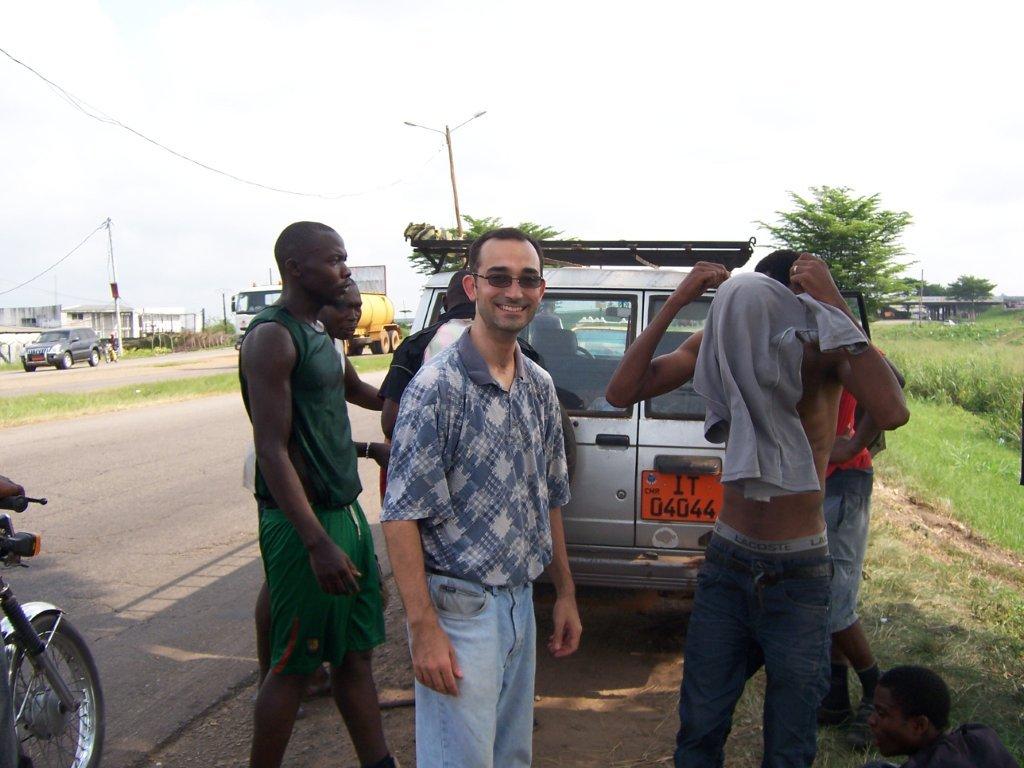
We had pulled over near a soccer game, on the main road in front of the Douala international airport and within a few seconds had an army of helpers to assist us. So we grabbed the tools and tried to loosen the lug nuts, they were not going to move, I even had 2 Cameroonians that jumped up and down on the end of the wrench to try. So I paid someone to go try and find some tools for us. He came back about 5 minutes later with the tools in hand, we got the tire off and the spare put on and when they went to lower the jack somehow the hydraulic center broke and we couldn’t lower the car, so they lifted up the car and I pulled out the jack.
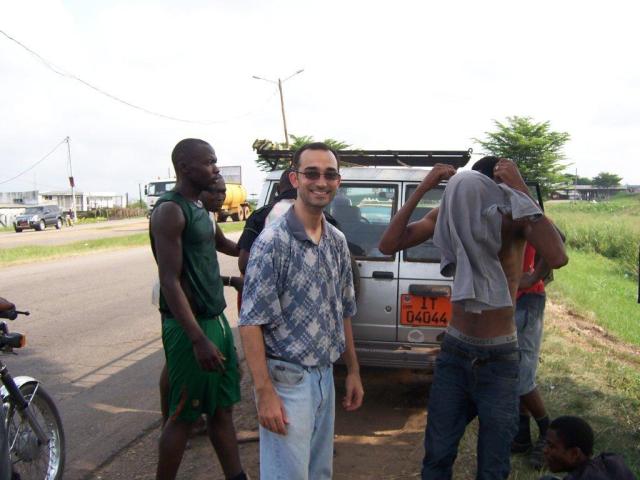
But when we went to leave the young man who had went and gotten the tools realized that a taxi that stopped to help us took some of the tools he had, so I had to give him money to cover the price of the tools so he could get his identification card back. I gave all our helpers a few dollars and we were back on our way.
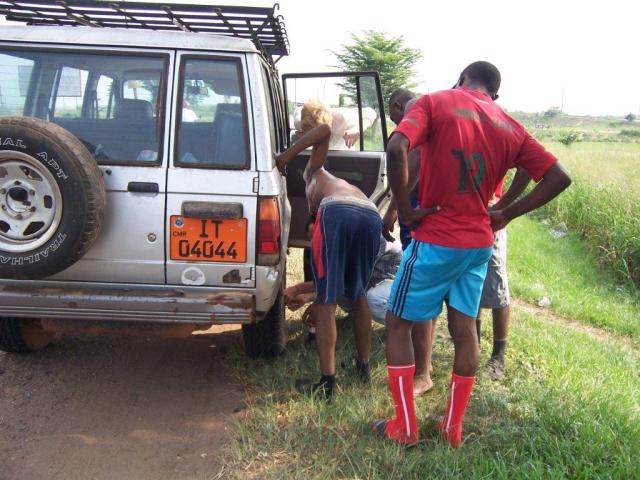
With the weight of the car on the spare we saw the spare was very low on air, so we slowly drove about one kilometer to the gas station where there was also a “tire repair” center. We pulled up to the tire repair center and asked them to fill it up our low tire and asked them to patch up the inner tube that was punctured by a piece of rebar. I’ve had plenty of tires patched here, and normally they can do it in 10-15 minutes. After over an hour and half of sitting in the sun I asked him to stop working on airing up the tire and give it back to us. Every time he put the tire back on he caused another leak. So we had another tire to serve as a spare if needed on the 200 km we had yet to travel to get back to Yaoundé.
We had gone about another 50 km and we heard this horrible noise, the treads from the spare tire had separated from the tire. So now we are in the middle of nowhere, with no jack and no tools and there weren’t very many cars on the road. So I managed to flag down a friendly car who couldn’t believe that I didn’t have a jack or the right tools, but the lug nuts on my car were a different size then his and he suggested that we were only 15 km from the next town of Edea, this was where we had the car fixed on the way to Tombel, and since the inner tube was still good I could drive slow to get there. Taking their advice we started slowly going when a young man ran up beside the car, I really was going very slowly, and told me there was a problem with my tire. I explained I didn’t have the tools or a jack to change it. He asked me to pull into his grandfather’s field which was the next turn a few feet up the road, it didn’t really look like a turn but I took his word for it.
He gets his grandfather who asked where the jack and tools were and I explained that I didn’t have them, but we tried the socket wrench again, same results as before.
So he sent his grandson to find someone who had tools, he was gone for about 10 minutes and came back and explained that they had not gotten out of church yet but he called one of his friends. The tools arrived but we still didn’t have a jack, so he grabbed several small boards and stacked them up and asked me to back up the flat tire onto the boards, then he put a log under the frame of the car to help prop it up. He took off the tire, pulled the boards out but the car was not high enough off the ground to put on the tire that we had partially repaired earlier in the day. So they dug down in the dirt around where the tire needed to go. We put on the other tire and we were back on the road, these guys wouldn’t let us take their picture of the work they were doing nor would they accept any money.
So with our tire on with a slow leak we were off again. We made it to Edea and pulled into the first shop I saw that had tires stacked up out front that made me think they would be able to repair the tire. I once again had to explain that I didn’t have a jack and I didn’t have any tools. Well neither did they, but they knew someone up the street who I could rent them from. So I went up talked to him and negotiated a price on tool rental and then they took off the tire. I then looked at the inner tube and asked if they could just replace it, they didn’t have any, but they knew someone who did; the same guy who rented me the tools. I went back and asked him how much for a new inner tube, he told me and went to get it. But it wasn’t the same size. I told him no, I need the same size finally he found a used one that we agreed on a price after a few minutes. I took it to the repair shop and they had it fixed in 10 minutes. I also found a fire extinguisher in this town while waiting for the repairs. The others riding with me asked if I was going to repair the other spare tire and I told them no, if we had another problem we would park the car and take a bush taxi the remaining hour and a half to Yaoundé.
Thankfully we made it back to Yaoundé without any further incident.
On the road again
Last week I shared about the Bible dedication that I was able to attend, but the journey there and back was just as eventful. I was driving an older bowered car that has worked just fine for us driving around town in Yaoundé. (We are very grateful that we have a car to borrow)
We were about 100 km outside of Yaoundé when the car starting dying and we were having a difficult time going up the hills. The car was backfiring really badly and a motorcycle even flagged me to pull over because they were so concerned. They told me that I was spraying gas at them. I found out I was only about 15 km from the next town so I thought we could slowly limp into town and have a mechanic look at it. We tried to sing worship songs to keep the car moving, but we seemed to be struggling to remember second verses to the songs.
The vehicle died as we arrived in town right at the first building, which happened to be the mechanic.
I was hoping my French vocabulary for car parts had improved but I don’t have that great have vocabulary in English for car parts, there is the thingamajig attached to the wheel which is making a noise. The word I use in French for thingamajig is truc, which stands for almost anything when talking about car problems.
So after the mechanic looked at the car and told me that the bougies were bad. I thought, when did cars run on candles? In French a bougie is a candle. So I asked him if he could get bougies locally and how much. He told me he could get them and proceeded to fix it, along with his 5 apprentices that were watching everything he did. Then he wanted to take me for a drive to prove that he in fact fixed it.
So after a slight break of an hour or so we were back on the road!
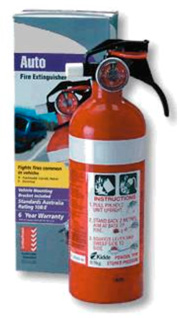
We made it through Douala, largest city in Cameroon, and on our way out of town we were stopped once again at a check point; this was the fifth time today. This was a big check point; they had tons of cars pulled over. Normally they ask for your identification, insurance and registration. They did that and then asked to see the fire extinguisher. I explained I wasn’t a commercial car so I didn’t need one. That didn’t work so I had to go over to the policeman sitting in the tent with a copy of the traffic regulations, and he showed me the line that said I was in violation. I asked for a warning, and he told me that I wouldn’t have to pay again today, as long as I didn’t lose my copy of the ticket. So I paid the $50 fine and we were back on the road again.
The rest of the drive through the banana fields was uneventful.
Not to spoil the next post, but the drive home was even more eventful…
Akosse Bible Dedication Part IV
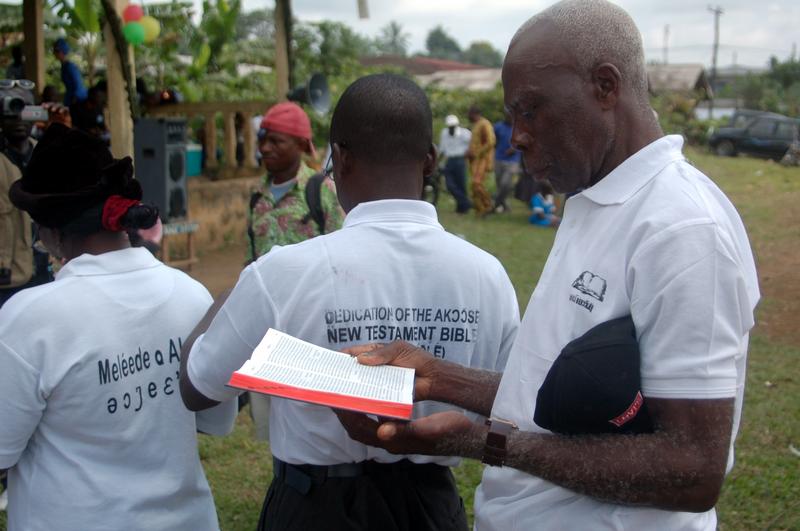
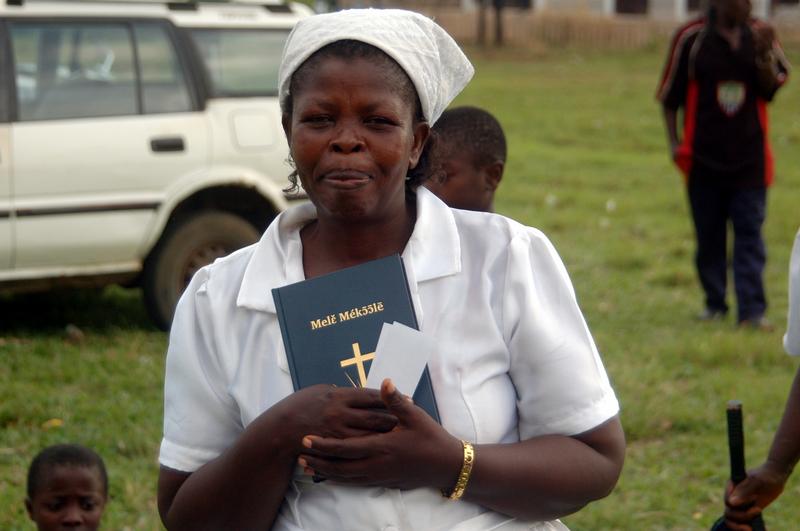
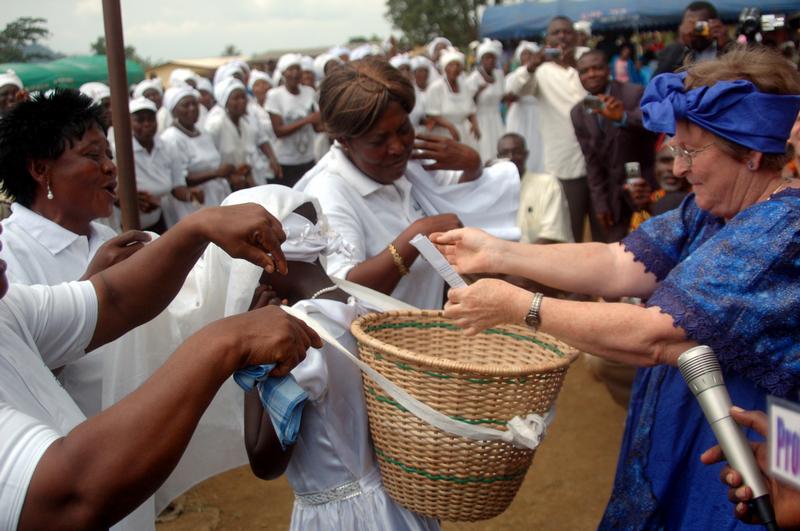
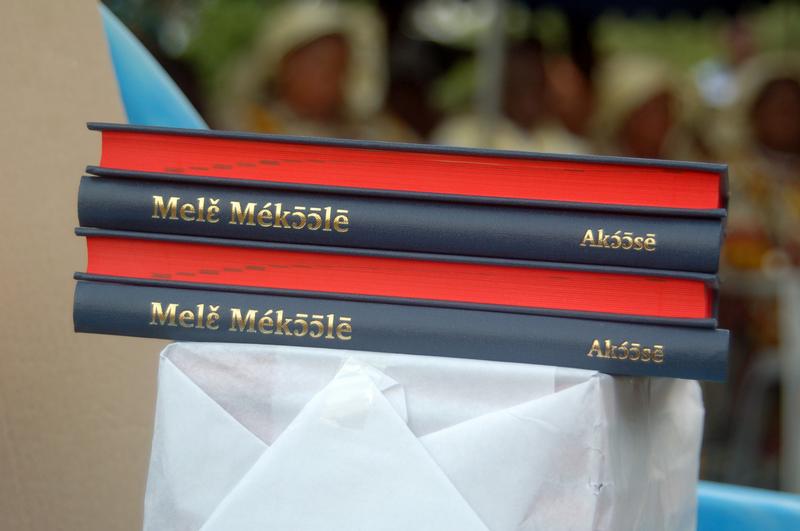
This is the final post on the Akosse dedication all though there are many more stories I could share from the event of all the ten different church choirs from every denomination and the processional in which one of the choirs dressed all in white brought the New Testament in a basket on the back of a young girl who was completely covered until the veil was removed and revealed the New Testament.
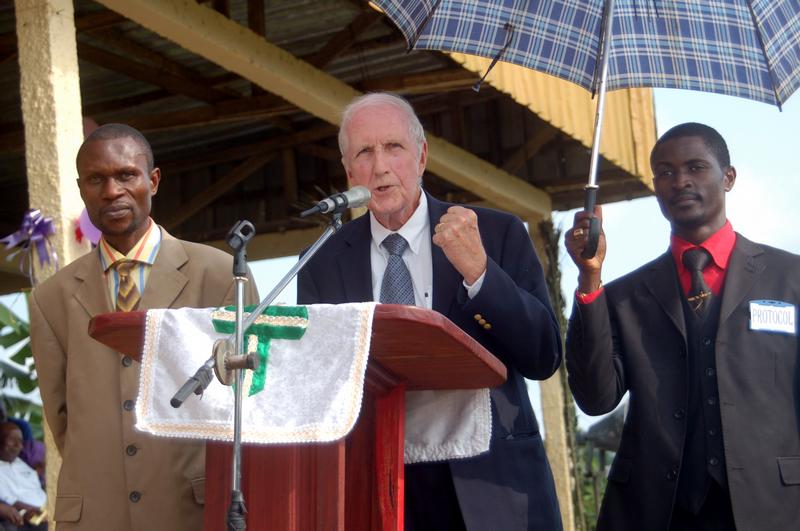
Ernie Fredrick was visiting Cameroon for the 16th time in the last 16 years and this time was to celebrate the dedication of the Akosse New Testament. He worked to encourage the local churches and pastors when he came to visit Cameroon and also to raise awareness of their various needs in Pittsburgh, Pennsylvania. His work helped unite 13 churches in Pittsburgh that were vital in allowing this Bible to come to completion, but what encouraged me most was that he shared that the life purpose that Jesus gave for us in Matthew 28:18-20 
Then Jesus came to them and said, “All authority in heaven and on earth has been given to me. Therefore go and make disciples of all nations, baptizing them in the name of the Father and of the Son and of the Holy Spirit, and teaching them to obey everything I have commanded you. And surely I am with you always, to the very end of the age.”
He challenged the Bakossi to be a great commission people. To GO and SHARE the good news.
Please pray that God will continue to bless the Bakossi and that they will GO and SHARE what they now have in their own language to those who are still waiting.
Akosse Bible Dedication Part III
The day continued with many more speeches and then we got to the main sermon. It was preached by a local pastor on Matthew 20:1-13 on the parable of workers in the vineyard.
He started off by having the text read by one of the translators in Akosse then he apologized for not being able to read in his mother tongue but he was going to be attending the literacy class so he could bring the Word of God in his mother tongue.
He shared that the gospel was first brought to Tombel 115 years ago and that they were not late in receiving their New Testament but they received it at just the right time that God had planned, and the 30 other languages that he knows near Tombel that are still waiting will also not be late but will receive it at just the right time. He also was grateful for the courage of the translators. There can be great risk when translating the Bible that something could be added or subtracted but he was glad that many of the risks were minimized with the many checks that are put into place when there is a translation project.
He reminded us that Jesus was talking about the Kingdom of God in this parable. He shared that the Bakossi people are farmers and they understand that people go to work at different times throughout the day, but it goes against our way of thinking to pay everyone the same amount for different work. In this parable God turned the tables upside down and everyone gets paid the same. God turns our common stuff upside down. He emphasized that Everything is God’s business.
He ended that when he hears the Bible read in his mother tongue of Akosse he receives it differently. His soul is lifted and nothing needs to be added or subtracted. We’ve danced in the dark for too long because of misunderstandings, but now there can be no misunderstandings.
“So the last will be first, and the first will be last.” Matthew 20:16
Pray for all those that are able to read Akosse and for those that are beginning to learn how to read that God will open their eyes and hearts to his eternal truths.
Akosse Bible Dedication Part II
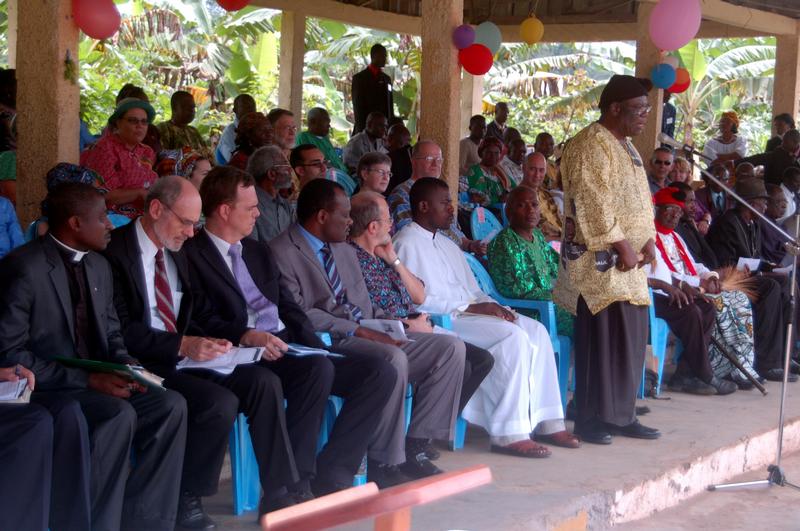
The first speaker of the day was the chief of the village. He shared a story from his days of a child that if you greeted a white man in English you could end up with a penny. One day he did this and he was asked why don’t you speak your birth language? He was shocked at the response and didn’t get his penny. But he soon realized that the missionary wanted him to understand that things could be better understood in his birth language and this strange person wanted to learn it.
Those missionaries wanted to learn his language and because they understood that the Word of God could be better understood in the mother tongue.
The chief then shared two blessings, the first was that communication was better understood in Akosse and the second was that he was alive to see the dedication of the New Testament. He then remarked that this is not the end of decades of work but a new beginning for the Bakossi people.
Then he ended with the statement that he hopes all those who are visiting will be protected by our ancestors and our God. Those sitting around me just looked at each other to verify what we thought we heard him say. One of the great strongholds in Cameroon is the power that African Traditional Religion has over people. Even in the church there are many who do not see a problem with it.
Do not conform any longer to the pattern of this world, but be transformed by the renewing of your mind. Then you will be able to test and approve what God’s will is—his good, pleasing and perfect will. (Romans 12:2)
Please pray for the Bakossi people as they begin to read their own New Testaments and that all of us will not conform to to the patterns of this world. Pray for those who have had to turn away from their families because they understand that the worship of ancestors goes against God’s plan.